Survey for How Teen Pregnancy's Baby End Up
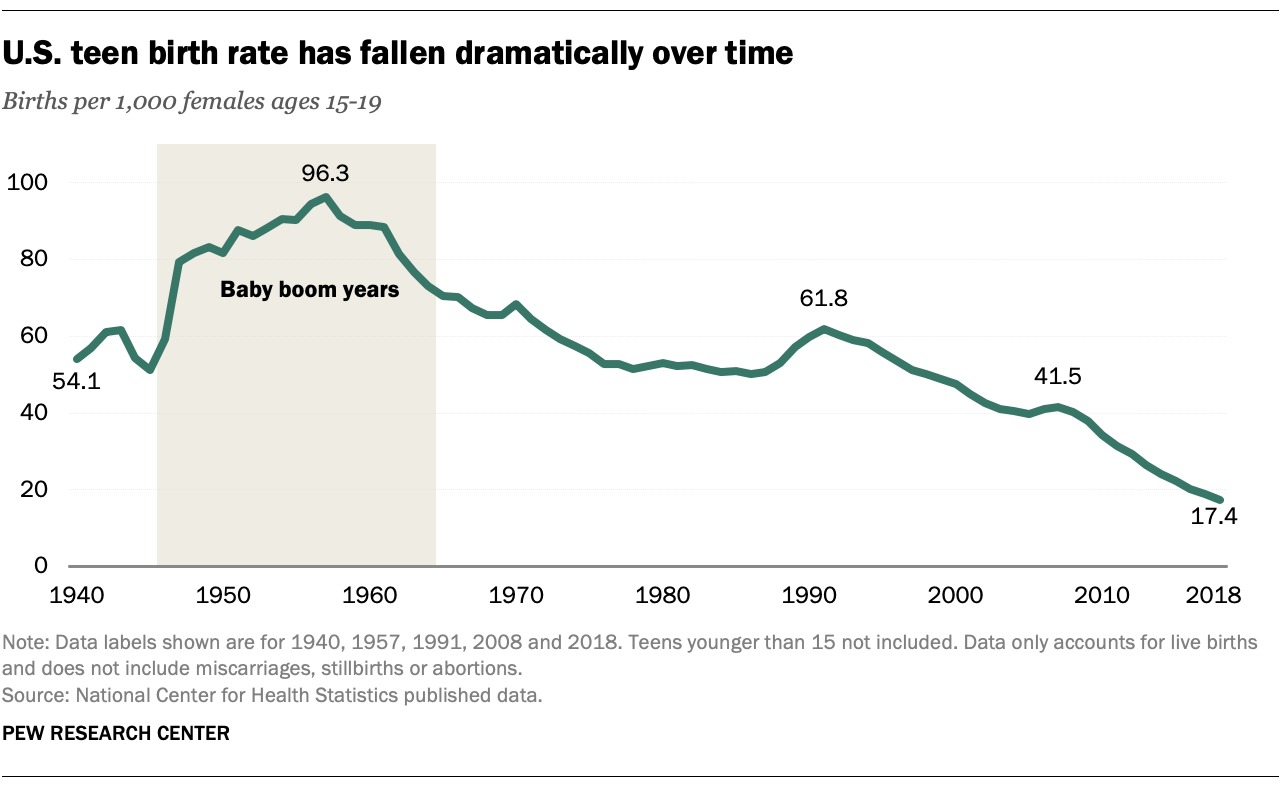 The teen birth rate in the United states is at a record low, dropping beneath eighteen births per 1,000 girls and women ages 15 to nineteen for the first time since the government began regularly collecting data on this group, according to a Pew Research Center analysis of newly released data from the National Heart for Health Statistics.
In 2018, the birth charge per unit among 15- to nineteen-twelvemonth-one-time girls and women was less than one-half of what it had been in 2008 (41.5 births per ane,000). Asians and Pacific Islanders led the way over this time, followed by Hispanics, with teen nativity rate declines of 74% and 65%, respectively. Rates for white and black teens fell past more than 50% over the by decade also.
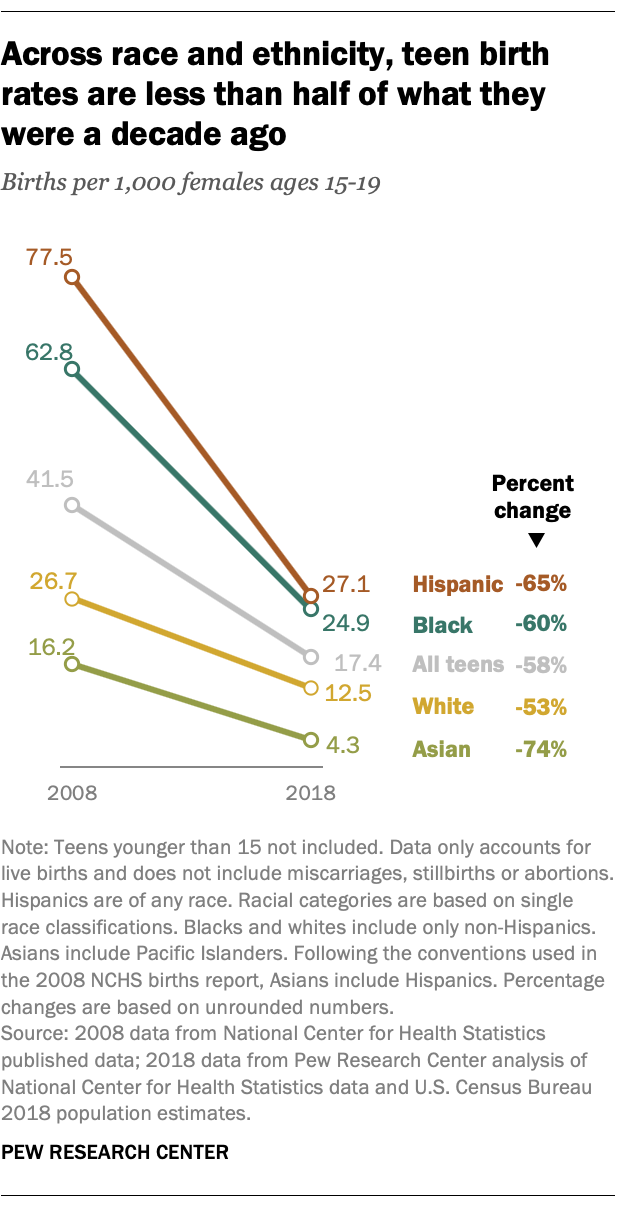 Despite rapid declines in teen nascency rates beyond all major racial and ethnic groups, disparities persist. In 2018, the nascence rate for Hispanic and black teens ages fifteen to 19 was almost double the charge per unit among white teens and more five times as high every bit the rate among Asians and Pacific Islanders.
Teen birth rates peaked at 96.3 per 1,000 in 1957, the midst of the babe blast, after having risen dramatically following the finish of World War 2. But the composition of teen mothers has inverse drastically. Back in 1960, most teen mothers – an estimated 85% – were married. Today, the bulk of teen births (89%) are to single mothers.
The teen nascence rate has been on a steep turn down since the early 1990s, and that tendency accelerated after the onset of the Swell Recession in 2007.
What's behind the recent trends?
I possible factor is the economic system: A Pew Research Center assay in 2011 tied the declining birth rate to the economic downturn of the recession. But this trend in teen birth rates has continued fifty-fifty as the economy has recovered, and nascence rates for teens take fallen faster than they have for all women ages 15 to 44 (58% and iv% declines, respectively, from 2008 to 2018).
What else may be contributing to the decline in teen nativity rates? Less sex, use of more than effective contraception and more information nigh pregnancy prevention.
For ane affair, at that place has been a significant decline in the percentage of never-married girls and women ages 15 to 19 who report that they accept e'er had sex, from 51% in 1988 to 42% in 2011-15, according to National Survey of Family unit Growth data. Among those teens who have had sex, the bulk (81% of females and 84% of males) used a contraceptive method the first time they had sexual activity. This figure has non inverse significantly for males, merely information technology has increased for females since 2002, when 74.5% used contraception.
Moreover, the share of teens using some form of highly effective contraceptive methods is increasing. The share of sexually active female teens who have used emergency contraception (eastward.one thousand., the morning-after pill) rose from 8% in 2002 to 23% in 2011-15. And a Centers for Disease Control and Prevention analysis of the roughly 600,000 low-income teens who used the Championship X National Family Planning Plan for contraception found that the use of long-acting reversible contraceptives such equally IUDs and implants – which are considered more effective than other means of contraception – rose from 0.iv% in 2005 to seven.1% by 2013.
Pregnancy prevention programs and messages directed toward teens may also have played a part. A 2014 Brookings report found that reality Tv set shows that follow the struggles of teen mothers like the MTV programs 16 and Significant and Teen Mom may take contributed to up to a third of the decline in teen births from June 2009, when they began ambulation, through the end of 2010.
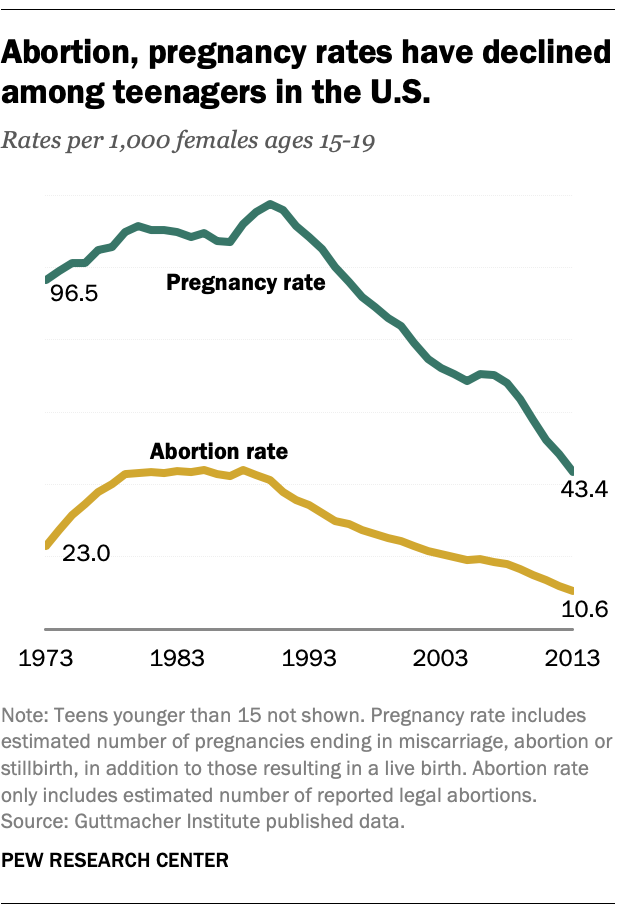 It'south worth noting that nascency rate figures only include alive births. In 2013, the estimated teen pregnancy charge per unit – which reflects not just live births, but too miscarriages, stillbirths and abortions – was 43.4 pregnancies per i,000 females ages fifteen to 19. This marks a steep pass up, particularly since 1990, when the pregnancy rate among teens peaked at 117.6.
The abortion rate amidst xv- to xix-year-old girls and women has too been declining, from 44.0 per 1,000 in 1988 to x.6 in 2013. Of the roughly 450,000 pregnancies among teens in 2013, about 61% are estimated to take ended in live births, 24% in abortions and 15% in miscarriages or stillbirths.
Note: This is an update of a post originally published on April 21, 2014 , which was written by Eileen Patten, a sometime inquiry analyst at Pew Research Center.

Gretchen Livingston is a former senior researcher focusing on fertility and family demographics at Pew Research Centre.
Deja Thomas is a one-time research banana focusing on social and demographic trends.
Source: https://www.pewresearch.org/fact-tank/2019/08/02/why-is-the-teen-birth-rate-falling/
0 Response to "Survey for How Teen Pregnancy's Baby End Up"
Post a Comment