Inspiriation for the Who - Wont Get Fooled Again
If y'all mention the Who to most musicians, the band name conjures up memories of Keith Moon'due south flatulent drumming, John Entwistle's orchestrated bass playing, and Roger Daltrey's powerful screams. But perhaps the most iconic of all the Who images is guitarist Pete Townshend doing windmills on a guitar while continuing in front end of towers of Hiwatt amps. The image of Townshend'south theatrical gyrations onstage with a Gibson Les Paul or SG or his red Strat is probably the first thing that most retrieve of when nosotros hear a classic Who vocal.
But would you be surprised if I told yous that some of Townshend's nigh iconic recorded tones didn't come up from a Les Paul or a Strat driving huge walls of Hiwatt or Marshall amps? And then become ready.
Read on for a one-to-ane with Pete Townshend himself almost his memories of recording this song in 1971!
What Guitar/Amp Was That?
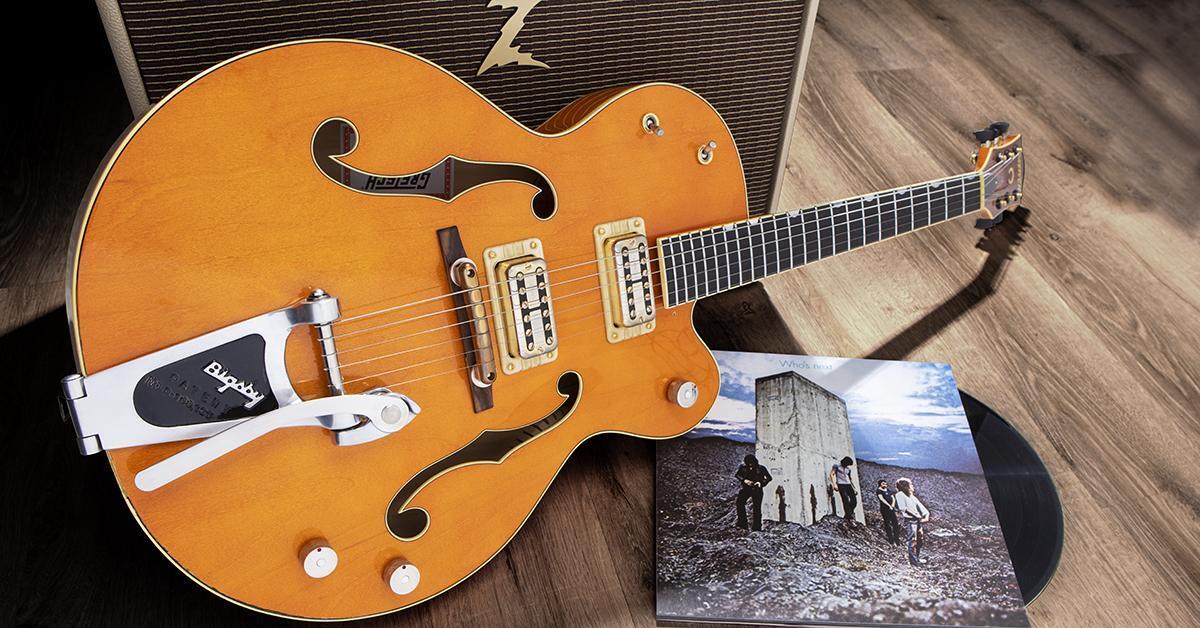
Some of the classic Who songs like "Won't Go Fooled Again," "Baba O'Riley," "Bargain," and "Backside Bluish Eyes" (all from Who's next, which was recorded 50 years ago), along with the album Quadrophenia, featured an unlikely guitar and amp combo — one you would never suspect. When I starting time heard about information technology, I honestly didn't believe it. This magic guitar-and-amp combination happened by risk in 1971. It started because Pete Townshend and friend Joe Walsh kept gifting gear to each other — swapping synths for guitars. I'll quote Townshend and Walsh hither from online interviews, starting with Townshend.
Townshend: I never really got into onetime guitars until Joe Walsh (James Gang) rang me up one dark and said, "I've got something for you lot," because we buy i another presents. He buys me old concert amps and I buy him synthesizers and nosotros have go very good friends. Anyhow, he said, "I've got something for you," and I said "What?" and he said, "A 1957 Gretsch. The one with existent f-holes." I said, "Groovy. Thank you, man," and it turned out to exist a real knockout. I was being polite. I opened the example and information technology was vivid orangish and I thought, "Ugh! It'south horrible. I hate it."
I went home and went into my studio and plugged it in and it totally wrecked me out, it's the best guitar I've got now. It's the Chet Atkins model, with double pickups, f-holes and single cut-away. ane
In addition to the Gretsch guitar, Joe Walsh too said:
Walsh: And I bought yous a Fender Bandmaster amplifier with iii 10s so the ohmage is crazy, and an Edwards pedal steel volume pedal. 2
As Townshend remembers it:
Townshend: I linked information technology all up, went "Ya-a-ang" and information technology was there. When I get those 3 things out and put them in a chain, information technology's a audio from paradise. 2
That "sound from paradise" was a revelation to Townshend, and it became the guitar sound he used predominantly on the Who's side by side tape that they started recording in March of 1971. The first recordings (not counting a failed attempt in New York) were at Mick Jagger's house, Stargroves, with the Rolling Stones Mobile Studio truck and engineer/producer Glyn Johns at the console.3
Accept a Heed
So, could we duplicate that archetype guitar tone today? Armed with all that info, Don Carr, Shawn Dealey, and I gathered up some gear, and hither's the guitar tone we came up with — inspired past Townshend'south guitar function on "Won't Go Fooled Once again." Earlier diving deep into the gear nosotros chose, take a heed. You'll hear the original recording intercut with our re-cosmos. How close do you call back we got? Annotation: The original track is panned slightly left and our guitar is panned to the right.
Re-creating the Tone
To try to mimic that amazing tone, we started where the historical road map led united states of america and grabbed a Gretsch 6120 (Don Carr'due south ain personal 2015 '59 reissue) and an amazing facsimile of the Fender Bandmaster, the Dr. Z Z-Master. (Read more about the fascinating history of how Joe Walsh had this amp congenital at the bottom of this article). Just like Townshend, we hooked it up and, quoting Townshend, "Ya-a-ang" — information technology, indeed, was magical. Instant smiles all around. I'll let Don Carr say a few words well-nigh the rig nosotros used and playing that classic riff.
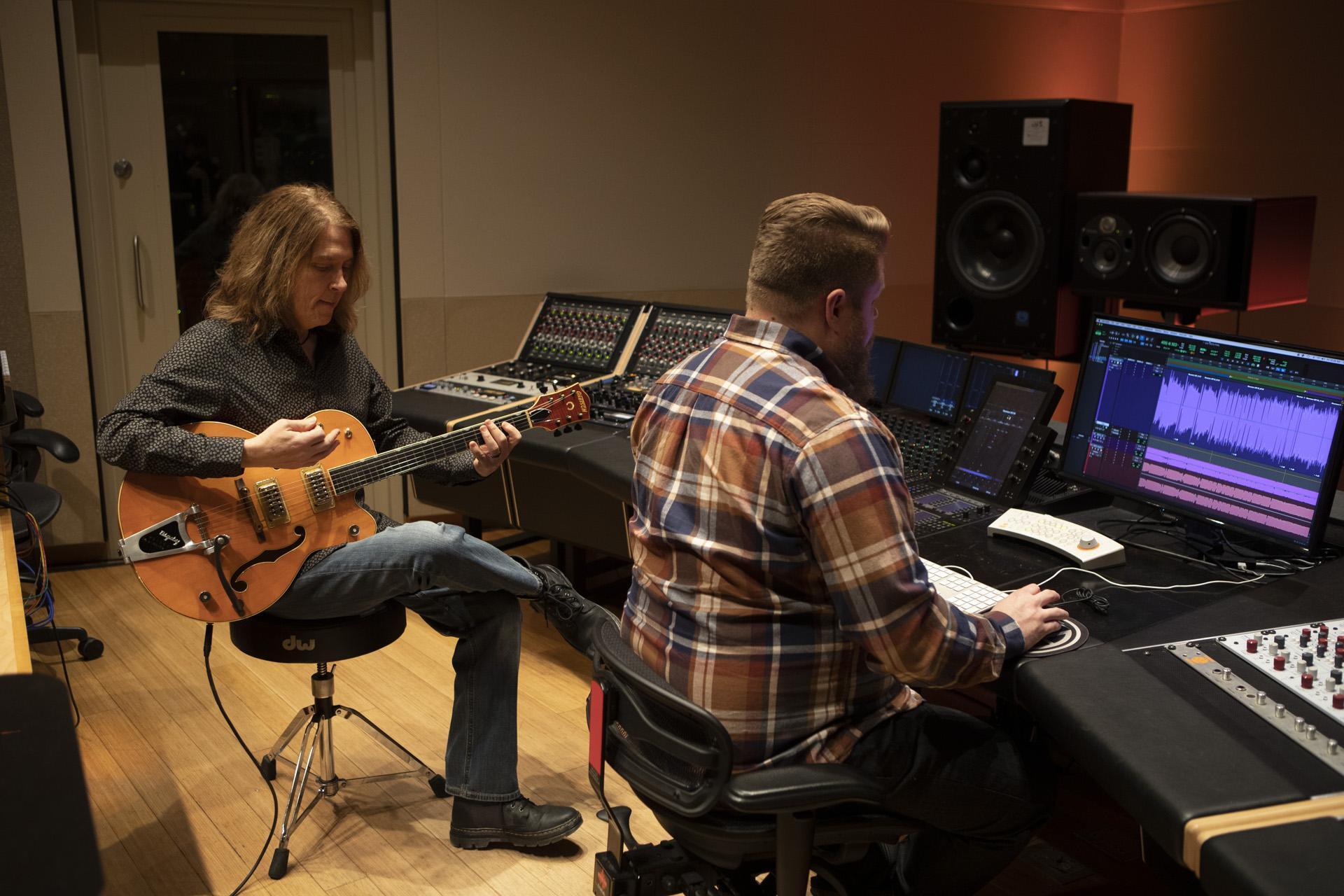
Don Carr About the Rig
Carr: The guitar-and-amp combination are unique, each with their own idiosyncrasies. The Gretsch 6120 sounds like a Gibson ES-175 meets a Fender Telecaster: a big hollowbody with a floating bridge and plenty of snap. Filter'Tron pickups are a big office of that equation, only so is the guitar's construction. An all-maple body with trestle bracing makes for a stiffer top, and the fact that the pickups and bridge are mounted to the internal-bracing contact points adds even more snap and quick response.
The three×x Fender Bandmaster, which the Z-Master famously replicates, is unique, even amidst Fender amps of that era. The apply of three speakers creates an impedance mismatch with the power amp, which creates some EQ anomalies. Also, the arrangement of three speakers in the chiffonier creates a point a few feet in forepart of the amp where the sounds of the speakers meet and create an interesting synergy. All multi-speaker guitar cabinets do this to some extent, but this 3×10 arrangement has a truly unique sound.
I specific point of involvement was Pete's use of an Edwards volume pedal. It's a photocell-based pedal originally designed for pedal-steel guitarists. Pete liked it because he could push the amp to the brink of feedback and back off or lean in as needed. Something else information technology provided was capacitance, which gently rolled off the high finish in the 6120/Bandmaster combination. We accomplished the same result with a 100-foot guitar cable since Edwards book pedals are incredibly finicky and as rare.
Don Carr Near the Performance
Carr: Anyone that'due south ever tried to play a Pete Townshend song or riff knows that the picking/strumming is critical. Pete's right-hand technique is not only vicious and aggressive simply also nimble and deadly accurate. Even something as straightforward as "Won't Get Fooled Again" requires a specific attitude and finesse to gauge; let's call it bombastic precision. A Gretsch 6120 with a Bigsby and a floating bridge tin can be overplayed, so just hitting hard isn't the answer. Information technology requires more of a snap or strike, like a snare pulsate or a bullwhip. Attempting to lucifer Pete'south legendary performance was very revealing in that regard. I definitely learned a lot.
Other Gear Nosotros Used
According to Glyn Johns, when remembering the tracking session for "Won't Become Fooled Again" at Stargroves:
Johns: Nosotros were recording at Mick [Jagger]'due south house, Stargroves near Newbury, and I'm exterior in the studio truck, playing in the synthesiser and hearing them locked relentlessly on the beat correct through the song. I was diddled away. I knew it was a marker in the evolution of pop music. four
The rest of the recording was finished at Olympic Studios. My enquiry suggests that the preamps used were likely those in the Helios console at Olympicv. Since nosotros didn't have a Helios preamp, we experimented with several options and finally plant the right tone with the Chandler Express TG2-500 mic preamp. Nailed information technology. And the mic I chose (based on my research) was a Neumann U 67.
Mic Placement
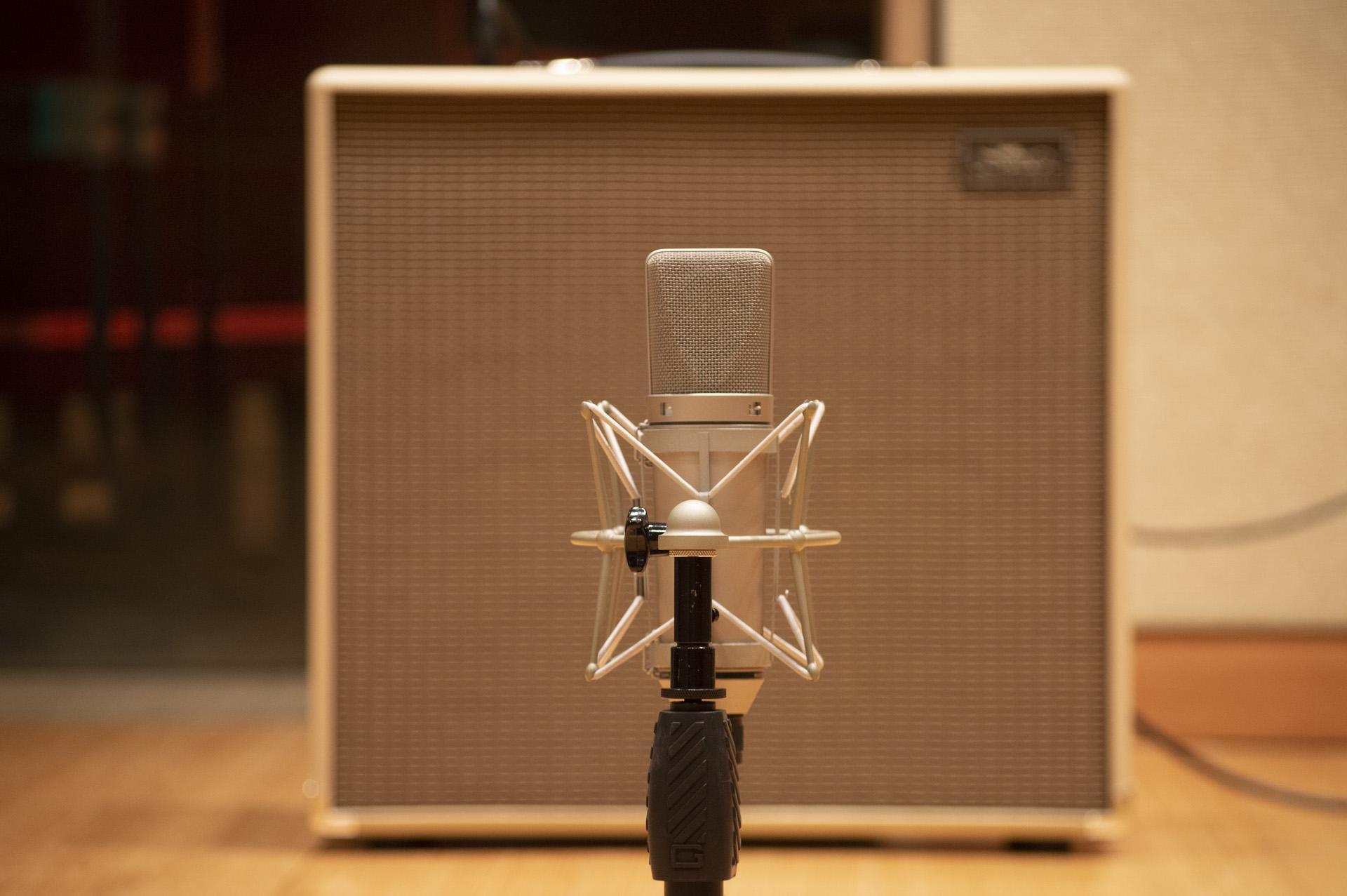
With the historical tape, putting together the right guitar gear seemed almost too easy. And then we started experimenting with mic placement. That was a different story. We excitedly started with the mic in a typical position, and the audio was . . . wrong.
With the U 67 centered on the Z-Master cabinet, we found that mic distance had a huge touch on the tone (duh). We started up close — iii inches off the grill — nope. Then we moved it gradually dorsum to six inches. Nope. Then dorsum further to 12 inches. Even worse. Then slid information technology dorsum to two feet. Absolutely not. Then gradually to three feet. Finally, the audio was starting to come up into focus.
I put in earplugs (that Z-Master wide open up is loud!) and slid the mic slowly away from the cabinet while engineer Shawn Dealey listened and Don played in the command room. I was sliding the mic back a few inches at a time. "Farther. Farther, further . . ." Then, "STOP!!"
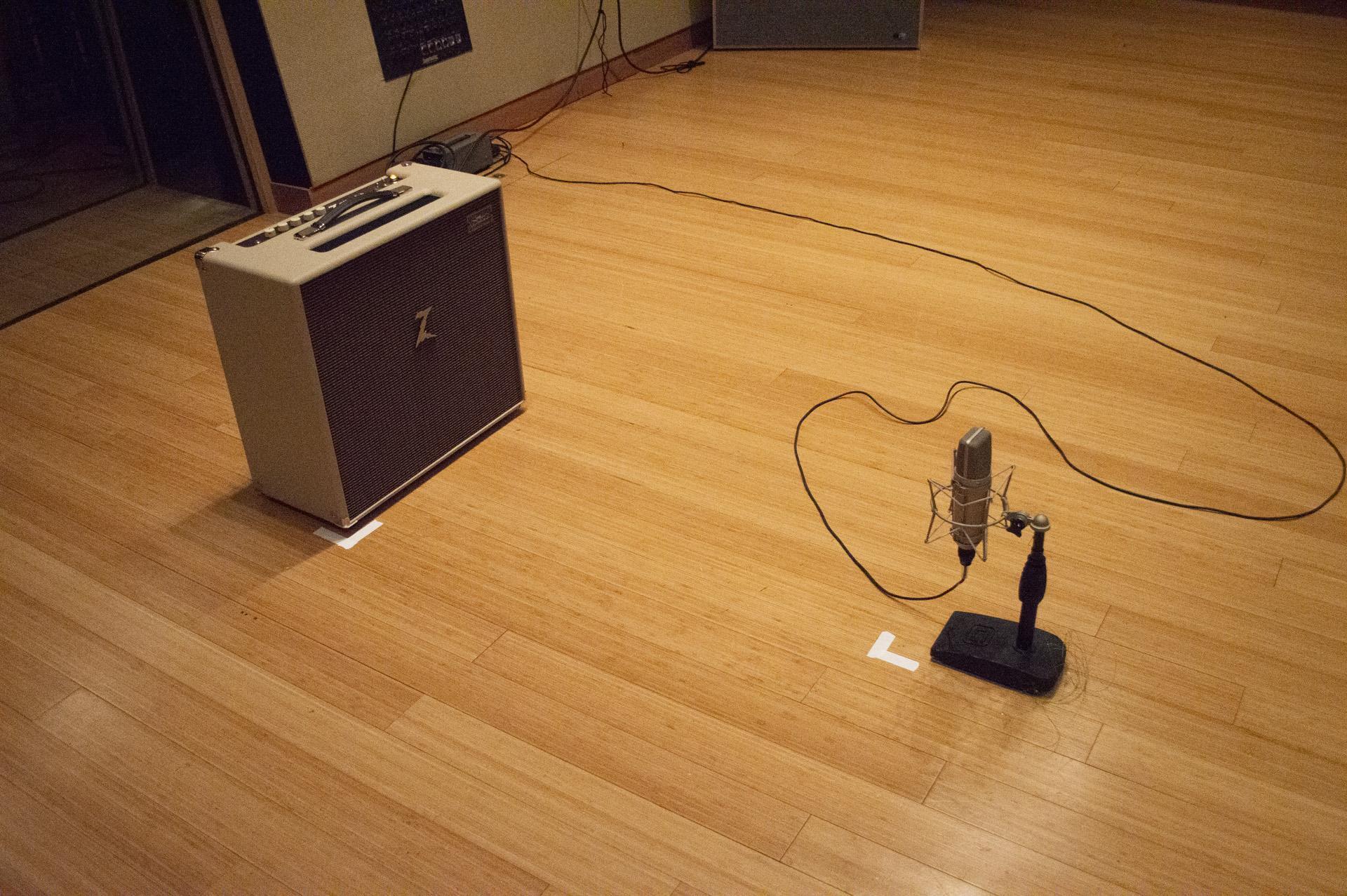
We institute the position where the tone was exactly right. Move the mic a few inches closer or farther abroad, and the sound changed from perfect to "not quite there." To demonstrate how farthermost the difference was (from good to horrid to amazing), we created this video of the self-moving Magic Mic so you can hear the difference for yourself. Listen to how drastically the tone changes as the mic moves away from the amp.
Permit's Hear from Pete Townshend Himself
Subsequently we finished the recording, I was delighted with the results. But coming up with that iconic guitar tone seemed almost too easy. Even afterwards all my research, reading scores of Townshend interviews over the years, I still had questions about the session that took place 50 years ago and how information technology all came together dorsum then.
So, I decided to become directly to the source. Connecting through his Sales Engineer, Kenny Bergle, I reached out to the man himself, Pete Townshend, with a list of questions. To my complete and utter anaesthesia, he replied — with answers that I (and probably y'all) have never heard earlier. (Yes, I'm withal in daze!)
Townshend: How-do-you-do Lynn,
First off , I am a fan and client of Sweetwater. I'll exist happy to endeavor to brand sense of your questions.
Best wishes,
Pete
Fuston: I noticed in this video about the making of Who'south next that you said you spent hours with the synth filter , modulating the organ sound. Understandably then, because it's hypnotic and, equally you said, " harmonically complex. " So , that sound really inspired that office. Was the same true of the guitar sound " inspiring the role " when you plugged in the Gretsch 6120 to the Bandmaster?
Townshend: Funnily plenty , I wrote the vocal on audio-visual. And that part (from my demo) is on the Who version. Glyn Johns liked the audio and performance and used it. We besides play it equally part of the backing track on stage.
The Gretsch electric sound was really first discovered on "Bargain." I think that was the first time I used the rig that Joe Walsh sent. I had gifted him an ARP 2600 , so he gifted me the rig that he said Neil Young was using at the fourth dimension. The clandestine is the Edwards pedal. Information technology doesn't interfere with the impedance (I don't think). The Gretsch volition feed back hugely immediately , and the pedal allows you to ride the crest of it. The amplifier is the old Bandmaster, and I still have it, and a new one , too, and they sound the aforementioned. Grungy!
On " Won't Get Fooled Once again ," in that location are two electric guitars. One is the stage rig. Then , SG with P90s into a Hiwatt . I and so carefully doubled (overdubbing) what I'd recorded using the Gretsch. At least, that'southward what I recall. When I become a chance , I will bank check out the Master 16-rails reel and make certain.
Fuston: You always had such amazing demos and, from the photos I've seen, had astonishing gear when yous were recording at abode. Was it hard to meliorate on those demos when you went into a commercial studio such equally Olympic? Or did you lot keep parts of the demos and contain them into the masters?
Townshend: I think I answered this above. Glyn was always ready to use my demo parts. I had Dolby A on my 8 – track machine, a Neve panel (Glyn hated Neves!) , and Neumann U 87 microphones. Information technology wasn't difficult to meliorate on my demos, but the tracks often went off sideways. That said, Keith Moon and John Entwistle were both respectful of what I may have played on drums or bass , but only used the very all-time $.25. Quite right.
Fuston: Every bit an engineer myself, I wanted to ask about your working relationship with Glyn Johns. What value did he bring to the sessions as your engineer/producer? He frequently talks about how great your demos were and what a challenge it was to try to improve on those. Did he push you to practice ameliorate or just make it audio better?
Townshend: I wanted to emulate The Ring!! They recorded themselves. Glyn was a difficult man. He could be quite tricky with some people. He liked to piece of work quickly. We liked to work slowly! He and Roger never got on. Simply he respected me , and me him. Nosotros got on well and have remained friends. I used multi- mics on drums at home, shut – miked. A mic on every drum. The sound I wanted was like Levon Helm : tight, damp, and funky. Glyn liked a bigger sound , simply , every bit is well known , oft merely used three or occasionally four microphones. He built the sound with delayed reverb and incredibly careful mic positioning. Sometimes he'd come out into the studio and motion a mic about a millimetre , and I'd call back he was being nuts. But information technology made a difference. He could hear phase issues I would miss.
Glyn's all-time trick was with acoustic guitars. Specially with my J – 200 with Melody-o-matic metal bridges — Keith Richards had the aforementioned guitar. ( " Wild Horses " is where you lot hear that Stones' sound at its best). Glyn set the microphone upward unusually far abroad from the sound hole, sometimes equally much every bit 9 inches. Even more sometimes. He used Neumann U 67s rather than smaller capsules like KM 84s that other engineers preferred. He used Helios 69 mic-pre modules ( 78s on " Won't Get Fooled " ), a tiny amount of 2.4 and 10k , and a touch of the minor Helios in-console compressor that was made by Audio & Blueprint, a UK visitor. Past the manner , the 500 S eries ADR compressor is a really skillful copy of that Helios compressor and sounds terrific on acoustic.
Fuston: In an interview you said , "I've never really enjoyed [touring that] much, but it'south a necessary part of the business. The joy of what I exercise has been in the composing, the writing, the playing around with studio gear." I sympathize. My question, then, is what studio gear or instruments inspire your inventiveness today? What are you excited about " playing around with " these days?
Townshend: Right now , I have the best dwelling studios ever. I take a lot of vintage stuff, and tape machines, but I practise love computers and was always waiting for them to arrive when I was young. I'm working with orchestration templates at the moment. I am preparing a synth studio , likewise , for big synths like Moogs so on. For me , the studio is like a train prepare , the music is like taking flight.
Fuston: Exercise you know what mic(s) Glyn Johns used on the guitar cabinet for "Won't Become Fooled Again?" (Hardly a fair question, I know, since it was 50 years ago.) Was it recorded alive directly into the Helios console at Olympic? Based on this soloed guitar runway , your guitar function sounds like it's all one take (with four short punches where the drums and bass drain disappear). That's amazing for an eight+ minute song. Nice punching, too!
Townshend: I think he used Shure SM56 and 57s. But I'm not sure.
Fuston: What was your standard recording setup (guitar/amp/mics) earlier you got the 6120/Bandmaster combo?
Townshend: Hiwatt stage rig. My guitar tech Alan Rogan was ever trying to get me to use small-scale amps, but I had an instant sound with my Hiwatts and SGs . It was but in the tardily ' 70s when I started to experiment a bit that I turned to smaller amps. In my abode studio , I use a Fender Princeton. Just I had a Hiwatt 4×12 in my basement with a head in the control room. Glyn never direct-injected guitar. I did at habitation, but merely to go really clean sounds. The Danelectro-Coral lipstick pickup DI-ed into a Neve 1066 sounds like glass, shining, glistening.
Fuston: What other guitarists from the early '70s did you adore or had a tone that inspired you? In this interview from 1983, you mentioned John Lee Hooker.
Townshend: Nobody really inspired my sound. I made it happen very early on in my career. I was trying to sound like an airplane . . . or like bombs in the second Earth War. I liked Howlin' Wolf'south guy — Hubert Sumlin. I had heard " Rumble " by Link Wray when I was starting upwardly, merely he didn't make a sound I particularly liked at the fourth dimension because I was studying Kenny Burrell and Wes Montgomery. R&B came a little later for me. Later I became friends with Link when he came to Britain , and I realised he had been making that distorted sound long before anyone else (except John Lee Hooker , who was doing it in 1949!).
Fuston: What was it virtually the Bandmaster that fabricated it sound then unique compared to the other Fenders, Marshalls, and Hiwatt amps yous used?
Townshend: It was a filthy sound when turned upwards besides loud. I started with Fender amps. Bought my first Fender Pro Amp with fifteen -inch JBL speaker in late 1963 as advised by the office-time salesman at Selmer ' s, one Johnny McLaughlin!! Very make clean sound. My influence then was Steve Cropper. It was that amp, and the Fender Bassman John Entwistle used, that we harnessed to Jim Marshall's first four×12 cabinets that had Celestion (UK) speakers. When Jim made his first head amp , he copied the Fender Bassman. Exactly , I recollect. I liked it , but information technology wasn't loud enough ; I was using it with my Fender Pro and a Bassman. So his tech guy (whose name I forget) doubled upwards the output stage and it was better, simply when Hiwatt brought out their amp , I preferred it. I like a lot of treble. Marshall took off though, large time, and most other players like Jimmy Page, Eric Clapton, and Jimi Hendrix preferred the more subtle tones of the Marshall amps.
I mainly use Fender amps in the studio and on phase. Merely I as well like Blackstar , Epiphone, Gibson, Lazy J, and some ' 80s Roland amps , too. Depends what I'm trying to exercise.
Hope this is useful.
Pete Townshend
Then, in that location y'all take information technology. Directly from the Who's mouth. Cheers, Pete, for filling in those cool details.
Conclusion
What a wonderful project this was. As a Who fan since the 1970s, the chance to copy Pete Townshend's iconic tone and even to represent with the fable himself was truly a "once in a lifetime" event.
Dr. Z's Z-Chief – Joe Walsh's Signature Amp
Inspired by the Fender Bandmaster that he gave Pete Townshend
In 2018, Joe Walsh approached Dr. Z to re-create his favorite amp of all time: a '57 Tweed Bandmaster three×10. While touring in the early '70s with the James Gang, Joe had gifted his original '57 Bandmaster to a particular windmilling British guitarist from the Who (Pete Townshend) who then used it to record the classic 1971 album Who'due south adjacent. Then, 50 years subsequently, Joe Walsh reached out to Mike Zaite (Dr. Z) and tasked him with recapturing the magic of that amp, the "1 that got away."
Starting with a to-spec replica of the paper-wound model 1848 output transformer past Triad Magnetics (the manufacturer of the original transformers of the Tweed era), Dr. Z made an exacting re-cosmos of the '57 Bandmaster and sent it off to Joe, who was ecstatic with the resulting amp. After in the yr, with some tweaks and tips suggested by Joe, Dr. Z completed the first prototype of what would become Joe's signature amp: the Z-Master.
What makes the Z-Master and so unique?
Role of the Z-Master'southward magic is that it runs iv ohms to 3 10-inch, 8-ohm speakers that are wired in parallel, equaling 3.2 ohms. That'due south the way it was in the original Bandmaster, which had a slight mismatch of output transformer to speaker load — that's part of the unique tone of the '57 Bandmaster.
Joe Walsh's Signature Amp
The Z-Primary was road tested through Joe'southward 2018 concert calendar, gracing the stage with the Eagles and Joe's solo band. Running three 12AX7s in the preamp and ii Tung-Sol 5881s in truthful triode wiring configuration, the Z-Master pumps out 30 watts through its unique 3×10 speaker configuration. It uses 3 ten-inch, paper vocalization coil, alnico speakers in an ultra-light, ultra-resonant cab for a full weight of 42 lbs. Finally, the Treble, Bass, and Presence controls are bachelor to make the final adjustments to suit the player and the room. As the start "signature series" amp in Dr. Z history, the Z-Master exhibits a wholly uncanny voice not dissimilar the man himself, Joe Walsh.
In an interesting sidenote, Mike Zaite has offered several times to build ane of his Z-Masters for Pete Townshend, who continues to decline. Co-ordinate to Townshend, "I've got the original. I don't need another."
More Iconic Guitar Tones
Here are other interesting manufactures in our Iconic Guitar Tones series that y'all may want to explore:
- Iconic Guitar Tones: Air-conditioning/DC's "Dorsum in Black"
- Iconic Guitar Tones: John Mayer'due south "Slow Dancing in a Burning Room"
Footnotes
- https://www.vguitarforums.com/smf/index.php?topic=8652.0
- http://www.thewho.cyberspace/whotabs/gear/guitar/fenderbandmaster.html
- https://en.wikipedia.org/wiki/Who%27s_Next
- https://world wide web.independent.co.uk/arts-amusement/music/features/glyn-johns-interview-my-50-years-producing-rock-classics-9830884.html
- https://www.soundonsound.com/people/keith-grant-story-olympic-studios
Source: https://www.sweetwater.com/insync/iconic-guitar-tones-pete-townshend-wont-get-fooled-again-the-who/
0 Response to "Inspiriation for the Who - Wont Get Fooled Again"
Post a Comment